290+ Tree Riddles With Answers (Fun & Easy)
A complete, categorized collection of tree riddles — covering species, forests, fruit, and the parts of a tree itself — with the answer, a difficulty rating, and a short explanation tucked under every question.
“He that plants trees loves others besides himself.” — Thomas Fuller, 17th-century English writer, from his collection of proverbs and aphorisms.
Trees have been a go-to subject for riddles for about as long as riddles have existed — helped along by facts stranger than fiction, like Pando, a single aspen organism in Utah connected by one root system — they’re everywhere, every culture has its own, and a good tree riddle can be solved by a six-year-old or stump an adult, depending on how it’s written. That range is exactly what this page is built around.
Below you’ll find 290 tree riddles, organized into 15 themed sections and sorted from easy warm-ups to genuinely tricky trivia about record-breaking trees and forest ecosystems. Every riddle comes with its answer, a difficulty rating, and a short explanation of why that answer is correct, so you can use this list for a classroom nature unit, a scout meeting, or a family hike icebreaker. There’s a dedicated section for teachers near the end, plus riddles about trees in fruit, Christmas tree traditions, and even stories and mythology.
I’ve used an earlier version of the Kids and Parts of a Tree sections in an actual outdoor classroom setting, walking a group of students past real examples while they guessed. It worked far better than reading the same riddles off a worksheet indoors — if you’re a teacher planning something similar, the Riddles for Teachers section has a few activity ideas built in, and our library riddles for kids collection pairs well with a broader reading and nature unit.
Key Takeaways
- 290 original tree riddles, organized into 15 sections from easy to hard.
- Every riddle includes an answer, a difficulty rating, and a short explanation.
- Sections cover tree species, parts of a tree, forests, fruit trees, and even trees in mythology.
- A dedicated section for teachers includes classroom and nature-walk activity ideas.
- Free to read, quiz with, print, or adapt for a classroom, scout meeting, or nature walk.
Warm-Up Tree Riddles (1–20)
Twenty gentle riddles about roots, leaves, and bark to open any tree-themed quiz. This section is part of our full list of tree riddles for every kind of reader.
I grow tall and wide, I never move from where I was planted, and I breathe in air that would harm you. What am I?
Reveal answer
Answer: A tree.
Difficulty: Medium
Why: Reread the clue and it clicks: a tree is the only thing that fits every part of the description.
I’m covered in rough skin that protects me from the weather, but I’m not an animal. What is this covering called?
Reveal answer
Answer: Bark.
Difficulty: Easy
Why: Most readers land on Bark once the clue’s specific detail clicks into place.
I have rings inside me that tell you exactly how old I am, but you’d have to cut me down to count them. What am I?
Reveal answer
Answer: A tree (counted by its growth rings).
Difficulty: Easy
Why: This riddle hinges on a detail unique to a tree (counted by its growth rings) — easy to miss on a first read, obvious on a second.
I reach toward the sky but I’m anchored firmly underground by parts you never see. What are these hidden parts?
Reveal answer
Answer: Roots.
Difficulty: Easy
Why: Most readers land on Roots once the clue’s specific detail clicks into place.
I turn sunlight into food, breathing in a gas that harms people and breathing out the one we need to live. What process am I describing?
Reveal answer
Answer: Photosynthesis.
Difficulty: Easy
Why: Photosynthesis is correct. It’s a detail most people recognize once they’ve seen it once.
I fall in autumn, turn brown, and crunch underfoot, yet I was once green and full of life. What am I?
Reveal answer
Answer: A leaf.
Difficulty: Easy
Why: As with many tree riddles, most readers land on a leaf once the clue’s specific detail clicks into place.
I’m the tallest living things on Earth, some of us reaching higher than a 30-story building. What are we?
Reveal answer
Answer: Trees (specifically very tall species like redwoods).
Difficulty: Medium
Why: Trees (specifically very tall species like redwoods) fits the description exactly; the wording rules out anything else once you reread it.
I’m a baby tree, small enough to step over, with my whole future still ahead of me. What am I?
Reveal answer
Answer: A sapling.
Difficulty: Easy
Why: A sapling is the answer — nothing else tied to trees matches every part of the clue.
I drop in autumn, and squirrels often bury me to eat later, though they don’t always remember where. What am I?
Reveal answer
Answer: An acorn (or a nut).
Difficulty: Easy
Why: The trick here is spotting the one detail that belongs only to an acorn (or a nut), rather than something more general.
I’m the thick, central trunk of a tree, hidden beneath the bark, carrying water from roots to leaves. What am I?
Reveal answer
Answer: The wood (or xylem).
Difficulty: Easy
Why: Reread the clue and it clicks: the wood (or xylem) is the only thing that fits every part of the description.
I’m a whole community of trees growing closely together, home to countless animals and plants. What am I?
Reveal answer
Answer: A forest.
Difficulty: Easy
Why: As with many tree riddles, reread the clue and it clicks: a forest is the only thing that fits every part of the description.
I lose all my leaves every autumn and grow them back fresh each spring. What kind of tree am I?
Reveal answer
Answer: A deciduous tree.
Difficulty: Easy
Why: Most readers land on a deciduous tree once the clue’s specific detail clicks into place.
I keep my leaves all year long, even through the coldest winter months. What kind of tree am I?
Reveal answer
Answer: An evergreen tree.
Difficulty: Medium
Why: This riddle hinges on a detail unique to an evergreen tree — easy to miss on a first read, obvious on a second.
I’m the sweet liquid tapped from a specific type of tree each spring to make a well-known breakfast syrup. What am I?
Reveal answer
Answer: Maple syrup (tapped from maple trees).
Difficulty: Easy
Why: Reread the clue and it clicks: Maple syrup (tapped from maple trees) is the only thing that fits every part of the description.
I’m thin and flat, usually green, and I’m the part of a tree most responsible for making its food. What am I?
Reveal answer
Answer: A leaf.
Difficulty: Easy
Why: A leaf is correct. It’s a detail most people recognize once they’ve seen it once.
I’m a tiny seed with wings, spinning like a helicopter as I fall from a maple tree. What am I?
Reveal answer
Answer: A maple seed (samara).
Difficulty: Easy
Why: As with many tree riddles, a maple seed (samara) is the answer — nothing else tied to trees matches every part of the clue.
I’m the process by which a seed begins to grow into a plant, breaking open and sending out a tiny root. What am I?
Reveal answer
Answer: Germination.
Difficulty: Easy
Why: Germination is correct. It’s a detail most people recognize once they’ve seen it once.
I’m cut down, processed, and turned into paper, furniture, and the frames of houses. What raw material am I?
Reveal answer
Answer: Wood (timber).
Difficulty: Easy
Why: The trick here is spotting the one detail that belongs only to Wood (timber), rather than something more general.
I’m the very top part of a tree, full of leaves and branches, where birds often build their nests. What part of the tree am I?
Reveal answer
Answer: The canopy (crown).
Difficulty: Medium
Why: The canopy (crown) is correct. It’s a detail most people recognize once they’ve seen it once.
I’m a tree so old that some of us have been alive for thousands of years, far longer than any human. What age-related fact am I describing?
Reveal answer
Answer: Tree longevity (some trees live thousands of years).
Difficulty: Easy
Why: The trick here is spotting the one detail that belongs only to Tree longevity (some trees live thousands of years), rather than something more general.
Tree Riddles for Kids (21–50)
Simple, playful tree riddles for younger readers, classroom activities, or a first nature lesson.
What tall, green plant has leaves, branches, and roots?
Reveal answer
Answer: A tree.
Difficulty: Medium
Why: As with many tree riddles, this riddle hinges on a detail unique to a tree — easy to miss on a first read, obvious on a second.
What covers the outside of a tree’s trunk, like a tree’s skin?
Reveal answer
Answer: Bark.
Difficulty: Easy
Why: Bark fits the description exactly; the wording rules out anything else once you reread it.
What do you call a baby tree that just started growing?
Reveal answer
Answer: A sapling.
Difficulty: Easy
Why: A sapling fits the description exactly; the wording rules out anything else once you reread it.
What part of a tree grows underground and soaks up water?
Reveal answer
Answer: The roots.
Difficulty: Easy
Why: Most readers land on the roots once the clue’s specific detail clicks into place.
What falls off trees every autumn and crunches when you step on it?
Reveal answer
Answer: Leaves.
Difficulty: Easy
Why: Reread the clue and it clicks: Leaves is the only thing that fits every part of the description.
What green part of a tree helps it make its own food from sunlight?
Reveal answer
Answer: A leaf.
Difficulty: Easy
Why: As with many tree riddles, a leaf fits the description exactly; the wording rules out anything else once you reread it.
What small, round nut do squirrels love to collect and bury?
Reveal answer
Answer: An acorn.
Difficulty: Medium
Why: It’s a fair riddle once you notice the specific detail buried in the wording — it points straight at an acorn.
What tree loses all of its leaves in the fall?
Reveal answer
Answer: A deciduous tree.
Difficulty: Easy
Why: A deciduous tree is correct. It’s a detail most people recognize once they’ve seen it once.
What tree keeps its leaves all winter long?
Reveal answer
Answer: An evergreen tree.
Difficulty: Easy
Why: Reread the clue and it clicks: an evergreen tree is the only thing that fits every part of the description.
What tall plant do birds build their nests in?
Reveal answer
Answer: A tree.
Difficulty: Easy
Why: This riddle hinges on a detail unique to a tree — easy to miss on a first read, obvious on a second.
What do you call a whole area covered in trees?
Reveal answer
Answer: A forest.
Difficulty: Easy
Why: A forest is the answer — nothing else tied to nature matches every part of the clue.
What sweet syrup comes from a tree and is poured on pancakes?
Reveal answer
Answer: Maple syrup.
Difficulty: Easy
Why: Reread the clue and it clicks: Maple syrup is the only thing that fits every part of the description.
What tree is traditionally decorated with lights and ornaments every December?
Reveal answer
Answer: A Christmas tree.
Difficulty: Medium
Why: This riddle hinges on a detail unique to a Christmas tree — easy to miss on a first read, obvious on a second.
What tree grows apples that you can pick and eat?
Reveal answer
Answer: An apple tree.
Difficulty: Easy
Why: An apple tree is the answer — nothing else tied to nature matches every part of the clue.
What hard material do you get when you cut down and process a tree?
Reveal answer
Answer: Wood.
Difficulty: Easy
Why: This riddle hinges on a detail unique to Wood — easy to miss on a first read, obvious on a second.
What climbs tree trunks and lives in holes, collecting nuts for winter?
Reveal answer
Answer: A squirrel.
Difficulty: Easy
Why: As with many tree riddles, a squirrel is the answer — nothing else tied to nature matches every part of the clue.
What tool do people use to cut down a tree?
Reveal answer
Answer: An axe (or a chainsaw).
Difficulty: Easy
Why: It’s a fair riddle once you notice the specific detail buried in the wording — it points straight at an axe (or a chainsaw).
What do you call the rings you see when you look at a tree stump?
Reveal answer
Answer: Growth rings (tree rings).
Difficulty: Easy
Why: This riddle hinges on a detail unique to Growth rings (tree rings) — easy to miss on a first read, obvious on a second.
What tree grows tall, straight, and is often used to make Christmas trees?
Reveal answer
Answer: A pine or fir tree.
Difficulty: Medium
Why: A pine or fir tree is the answer — nothing else tied to nature matches every part of the clue.
What insect builds its home high up in tree branches, out of paper-like material?
Reveal answer
Answer: A wasp (or hornet).
Difficulty: Easy
Why: Reread the clue and it clicks: a wasp (or hornet) is the only thing that fits every part of the description.
What tiny creature spins a web between two tree branches?
Reveal answer
Answer: A spider.
Difficulty: Easy
Why: As with many tree riddles, the trick here is spotting the one detail that belongs only to a spider, rather than something more general.
What swings from branch to branch using its long arms?
Reveal answer
Answer: A monkey.
Difficulty: Easy
Why: A monkey fits the description exactly; the wording rules out anything else once you reread it.
What do you call the very top, leafy part of a tree?
Reveal answer
Answer: The canopy.
Difficulty: Easy
Why: The trick here is spotting the one detail that belongs only to the canopy, rather than something more general.
What falls from an oak tree every autumn?
Reveal answer
Answer: Acorns.
Difficulty: Easy
Why: The trick here is spotting the one detail that belongs only to Acorns, rather than something more general.
What tall plant can grow for hundreds of years if nobody cuts it down?
Reveal answer
Answer: A tree.
Difficulty: Medium
Why: This riddle hinges on a detail unique to a tree — easy to miss on a first read, obvious on a second.
What do bees collect from flowering trees to make honey?
Reveal answer
Answer: Nectar (or pollen).
Difficulty: Easy
Why: As with many tree riddles, nectar (or pollen) is the answer — nothing else tied to nature matches every part of the clue.
What swing is often tied to a sturdy tree branch in a backyard?
Reveal answer
Answer: A tree swing (or tire swing).
Difficulty: Easy
Why: Most readers land on a tree swing (or tire swing) once the clue’s specific detail clicks into place.
What do you call a tree that produces cones instead of flowers?
Reveal answer
Answer: A conifer.
Difficulty: Easy
Why: A conifer fits the description exactly; the wording rules out anything else once you reread it.
What tree is often tapped in early spring to collect sweet sap?
Reveal answer
Answer: A maple tree.
Difficulty: Easy
Why: Most readers land on a maple tree once the clue’s specific detail clicks into place.
What tall, leafy plant provides shade on a hot summer day?
Reveal answer
Answer: A tree.
Difficulty: Easy
Why: The trick here is spotting the one detail that belongs only to a tree, rather than something more general.
Easy Tree Riddles With Answers (51–75)
A step up from the kids’ section, covering common tree species found in backyards and parks. It is one part of a much larger collection of tree riddles on this page.
I’m a tree with white bark that peels like paper, often found in cooler climates. What tree am I?
Reveal answer
Answer: A birch tree.
Difficulty: Medium
Why: As with many tree riddles, a birch tree is correct. It’s a detail most people recognize once they’ve seen it once.
I’m a tall, straight tree with needle-like leaves and pine cones hanging from my branches. What tree am I?
Reveal answer
Answer: A pine tree.
Difficulty: Easy
Why: Most readers land on a pine tree once the clue’s specific detail clicks into place.
I’m famous for my wide, flat leaves that turn brilliant red and orange in autumn, and for the sweet syrup made from my sap. What tree am I?
Reveal answer
Answer: A maple tree.
Difficulty: Easy
Why: Most readers land on a maple tree once the clue’s specific detail clicks into place.
I grow acorns, have deeply lobed leaves, and I’m one of the most common trees in many forests. What tree am I?
Reveal answer
Answer: An oak tree.
Difficulty: Easy
Why: This riddle hinges on a detail unique to an oak tree — easy to miss on a first read, obvious on a second.
I’m known for my thin, drooping branches that sway gracefully, often planted near rivers and ponds. What tree am I?
Reveal answer
Answer: A weeping willow.
Difficulty: Easy
Why: This riddle hinges on a detail unique to a weeping willow — easy to miss on a first read, obvious on a second.
I produce small, round fruit that’s pressed into cider or eaten fresh, and my blossoms are pink or white in spring. What tree am I?
Reveal answer
Answer: An apple tree.
Difficulty: Easy
Why: As with many tree riddles, an apple tree is correct. It’s a detail most people recognize once they’ve seen it once.
I grow in groves, produce small green or black fruit pressed for oil, and I’m closely tied to Mediterranean cuisine. What tree am I?
Reveal answer
Answer: An olive tree.
Difficulty: Medium
Why: This riddle hinges on a detail unique to an olive tree — easy to miss on a first read, obvious on a second.
I’m tall, straight, and my wood is often used for telephone poles and paper. My leaves tremble in even a light breeze. What tree am I?
Reveal answer
Answer: An aspen (or poplar) tree.
Difficulty: Easy
Why: An aspen (or poplar) tree fits the description exactly; the wording rules out anything else once you reread it.
I’m the tallest tree species on Earth, native to the coast of California. What tree am I?
Reveal answer
Answer: A coast redwood.
Difficulty: Easy
Why: Most readers land on a coast redwood once the clue’s specific detail clicks into place.
I produce cones instead of flowers and keep my needle-like leaves all winter long. What type of tree am I?
Reveal answer
Answer: A conifer.
Difficulty: Easy
Why: This riddle hinges on a detail unique to a conifer — easy to miss on a first read, obvious on a second.
I’m known for my distinctive, fan-shaped leaves, and I’m one of the oldest living tree species on the planet. What tree am I?
Reveal answer
Answer: A ginkgo tree.
Difficulty: Easy
Why: A ginkgo tree is the answer — nothing else tied to common tree species matches every part of the clue.
I’m often tapped in early spring, and my sweet sap is boiled down to make a popular breakfast syrup. What tree am I?
Reveal answer
Answer: A sugar maple.
Difficulty: Easy
Why: A sugar maple is the answer — nothing else tied to common tree species matches every part of the clue.
I grow in swampy wetlands, and my roots sometimes stick up out of the water like knobby knees. What tree am I?
Reveal answer
Answer: A bald cypress.
Difficulty: Medium
Why: This riddle hinges on a detail unique to a bald cypress — easy to miss on a first read, obvious on a second.
I’m covered in sharp needles, and in many countries I’m cut down each December to decorate inside homes. What tree am I?
Reveal answer
Answer: A fir (or spruce) tree, used as a Christmas tree.
Difficulty: Easy
Why: A fir (or spruce) tree, used as a Christmas tree is the answer — nothing else tied to common tree species matches every part of the clue.
I produce a hard, sweet nut inside a spiky green shell that splits open in autumn. What tree am I?
Reveal answer
Answer: A chestnut tree.
Difficulty: Easy
Why: It’s a fair riddle once you notice the specific detail buried in the wording — it points straight at a chestnut tree.
I grow in tropical climates, and my large leaves and tall, bare trunk are iconic on beaches worldwide. What tree am I?
Reveal answer
Answer: A palm tree.
Difficulty: Easy
Why: As with many tree riddles, most readers land on a palm tree once the clue’s specific detail clicks into place.
I’m known for my distinctive white, papery bark that’s often used to make canoes by Indigenous peoples in North America. What tree am I?
Reveal answer
Answer: A paper birch.
Difficulty: Easy
Why: It’s a fair riddle once you notice the specific detail buried in the wording — it points straight at a paper birch.
I grow citrus fruit, my blossoms smell sweet, and my fruit is often squeezed into juice. What kind of tree am I broadly describing?
Reveal answer
Answer: A citrus tree (like orange or lemon).
Difficulty: Easy
Why: A citrus tree (like orange or lemon) is the answer — nothing else tied to common tree species matches every part of the clue.
I’m a tree whose wood is extremely dense and dark, historically prized for furniture and piano keys. What tree am I?
Reveal answer
Answer: An ebony tree.
Difficulty: Medium
Why: The trick here is spotting the one detail that belongs only to an ebony tree, rather than something more general.
I grow very quickly, my wood is lightweight, and I’m often used for cheap furniture and paper pulp. What tree am I?
Reveal answer
Answer: A poplar tree.
Difficulty: Easy
Why: Most readers land on a poplar tree once the clue’s specific detail clicks into place.
I produce cones that only open and release seeds after being exposed to intense heat, like a forest fire. What tree am I?
Reveal answer
Answer: A lodgepole pine (or similar fire-adapted conifer).
Difficulty: Easy
Why: As with many tree riddles, most readers land on a lodgepole pine (or similar fire-adapted conifer) once the clue’s specific detail clicks into place.
I’m found in rainforests, and my massive buttress roots help keep me standing in shallow, wet soil. What kind of tree am I broadly describing?
Reveal answer
Answer: A rainforest tree (such as a kapok or ceiba).
Difficulty: Easy
Why: A rainforest tree (such as a kapok or ceiba) fits the description exactly; the wording rules out anything else once you reread it.
I’m often planted along city streets for shade, and my leaves are shaped like a star with five points. What tree am I?
Reveal answer
Answer: A sweetgum tree.
Difficulty: Easy
Why: It’s a fair riddle once you notice the specific detail buried in the wording — it points straight at a sweetgum tree.
I grow berries that are often used to flavor gin, and my sharp, prickly needles make me easy to identify. What tree am I?
Reveal answer
Answer: A juniper tree.
Difficulty: Easy
Why: A juniper tree is the answer — nothing else tied to common tree species matches every part of the clue.
I’m covered in thorns, grow in dry climates, and I’m often associated with the African savanna. What tree am I?
Reveal answer
Answer: An acacia tree.
Difficulty: Medium
Why: An acacia tree is correct. It’s a detail most people recognize once they’ve seen it once.
Classic Tree Riddles (76–100)
Well-rounded riddles about what makes a tree a tree, from roots to rings to seasons. You will find plenty more tree riddles further down the page too.
I stand still my whole life, yet I travel further than most living things, reaching higher into the sky each year. What am I?
Reveal answer
Answer: A tree.
Difficulty: Hard
Why: As with many tree riddles, reread the clue and it clicks: a tree is the only thing that fits every part of the description.
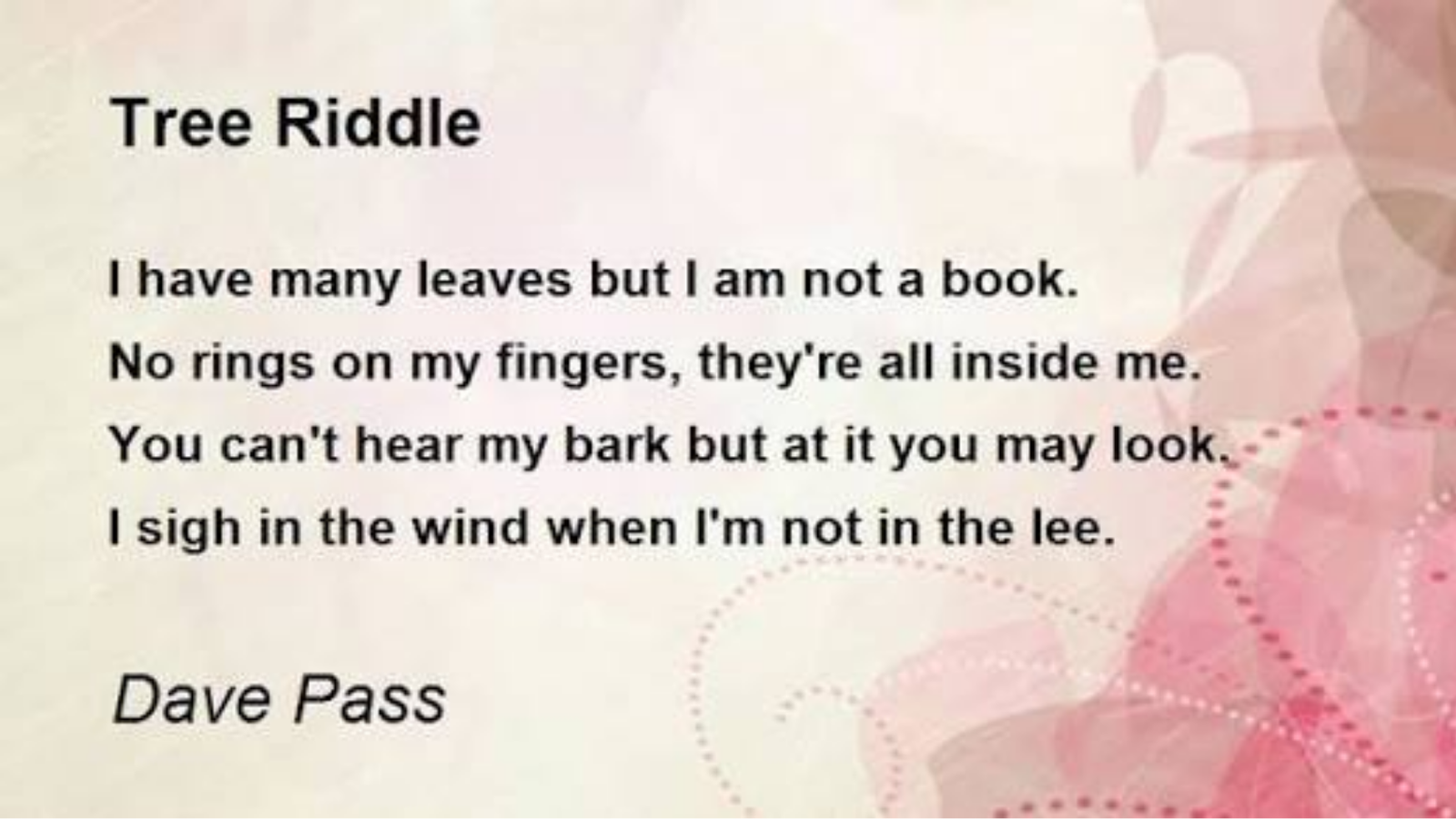
I have rings but no fingers, bark but no bite, and leaves but no pages. What am I?
Reveal answer
Answer: A tree.
Difficulty: Medium
Why: It’s a fair riddle once you notice the specific detail buried in the wording — it points straight at a tree.
The older I get, the more rings I carry inside me, each one marking a single year gone by. What am I?
Reveal answer
Answer: A tree.
Difficulty: Medium
Why: Reread the clue and it clicks: a tree is the only thing that fits every part of the description.
I drink through roots I can’t see, and I breathe through leaves that face the sun all day. What am I?
Reveal answer
Answer: A tree.
Difficulty: Medium
Why: A tree is correct. It’s a detail most people recognize once they’ve seen it once.
I give shade in summer, color in autumn, bareness in winter, and blossoms in spring, all without ever moving an inch. What am I?
Reveal answer
Answer: A deciduous tree, through the seasons.
Difficulty: Medium
Why: The trick here is spotting the one detail that belongs only to a deciduous tree, through the seasons, rather than something more general.
I stand taller than buildings, yet I started life small enough to fit inside a single seed. What am I?
Reveal answer
Answer: A tree.
Difficulty: Medium
Why: As with many tree riddles, most readers land on a tree once the clue’s specific detail clicks into place.
I’m cut down to build the very houses that people then decorate with pieces of my cousins each winter. What am I broadly describing?
Reveal answer
Answer: A tree (used for lumber and as a Christmas tree).
Difficulty: Hard
Why: A tree (used for lumber and as a Christmas tree) is correct. It’s a detail most people recognize once they’ve seen it once.
I have a trunk, but no suitcase, and limbs, but no body. What am I?
Reveal answer
Answer: A tree.
Difficulty: Medium
Why: A tree fits the description exactly; the wording rules out anything else once you reread it.
I’m home to birds, insects, and sometimes entire ecosystems, all without a single room or door. What am I?
Reveal answer
Answer: A tree.
Difficulty: Medium
Why: The trick here is spotting the one detail that belongs only to a tree, rather than something more general.
What has a bark but doesn’t bite?
Reveal answer
Answer: A dogwood tree (a classic pun on ‘bark’ and ‘dog’).
Difficulty: Easy
Why: A dogwood tree (a classic pun on ‘bark’ and ‘dog’) is the answer — nothing else tied to trees matches every part of the clue.
I lose my leaves every year, yet I’m not dying — I’m simply resting for the winter. What am I?
Reveal answer
Answer: A deciduous tree.
Difficulty: Medium
Why: As with many tree riddles, most readers land on a deciduous tree once the clue’s specific detail clicks into place.
I’m green all year, even buried in snow, while my neighbors stand bare through the cold months. What am I?
Reveal answer
Answer: An evergreen tree.
Difficulty: Medium
Why: This riddle hinges on a detail unique to an evergreen tree — easy to miss on a first read, obvious on a second.
I grow a new ring every single year, whether anyone’s counting or not. What am I?
Reveal answer
Answer: A tree.
Difficulty: Hard
Why: This riddle hinges on a detail unique to a tree — easy to miss on a first read, obvious on a second.
I can live for a single season or for thousands of years, depending entirely on what kind I am. What am I?
Reveal answer
Answer: A tree (depending on species).
Difficulty: Medium
Why: A tree (depending on species) is the answer — nothing else tied to trees matches every part of the clue.
I turn carbon dioxide into oxygen, quietly cleaning the air without anyone asking me to. What am I?
Reveal answer
Answer: A tree.
Difficulty: Medium
Why: A tree is correct. It’s a detail most people recognize once they’ve seen it once.
I’m often measured not in feet, but in the number of people needed to link hands around my trunk. What am I?
Reveal answer
Answer: A very large, old tree.
Difficulty: Medium
Why: Reread the clue and it clicks: a very large, old tree is the only thing that fits every part of the description.
I’m planted as a seed, grown as a sapling, and eventually become tall enough to shelter an entire family picnic beneath me. What am I?
Reveal answer
Answer: A tree.
Difficulty: Medium
Why: A tree fits the description exactly; the wording rules out anything else once you reread it.
I’m struck by lightning more often than almost anything else outdoors, simply because I stand the tallest in an open field. What am I?
Reveal answer
Answer: A tree.
Difficulty: Medium
Why: Most readers land on a tree once the clue’s specific detail clicks into place.
I shed my bark in papery strips rather than keeping one solid layer my whole life. What tree am I?
Reveal answer
Answer: A birch tree.
Difficulty: Hard
Why: Most readers land on a birch tree once the clue’s specific detail clicks into place.
I’m often the oldest living thing in an entire town, outliving the people who first planted me by centuries. What am I?
Reveal answer
Answer: An old tree (sometimes called a heritage or landmark tree).
Difficulty: Medium
Why: Reread the clue and it clicks: an old tree (sometimes called a heritage or landmark tree) is the only thing that fits every part of the description.
I provide the wood for violins, the paper for books, and the shade for a summer nap, all from the very same family of living things. What am I broadly describing?
Reveal answer
Answer: Trees (wood products).
Difficulty: Medium
Why: As with many tree riddles, it’s a fair riddle once you notice the specific detail buried in the wording — it points straight at Trees (wood products).
I’m often the single tallest living thing for miles around, visible long before anything else on the horizon. What am I?
Reveal answer
Answer: A tree.
Difficulty: Medium
Why: A tree fits the description exactly; the wording rules out anything else once you reread it.
I grow new leaves every spring without anyone ever planting them again. What am I?
Reveal answer
Answer: A deciduous tree, regrowing leaves each year.
Difficulty: Medium
Why: A deciduous tree, regrowing leaves each year fits the description exactly; the wording rules out anything else once you reread it.
I hold soil in place with my roots, preventing it from washing away during heavy rain. What am I?
Reveal answer
Answer: A tree.
Difficulty: Medium
Why: The trick here is spotting the one detail that belongs only to a tree, rather than something more general.
I’m often planted along streets specifically to cool nearby buildings and reduce energy use in summer. What am I?
Reveal answer
Answer: A shade tree.
Difficulty: Hard
Why: The trick here is spotting the one detail that belongs only to a shade tree, rather than something more general.
Funny Tree Riddles (101–125)
A lighter set of puns and silly riddles built around bark, branches, and leaves. This is just one round in a much bigger set of tree riddles.
Why did the tree go to the dentist?
Reveal answer
Answer: It needed a root canal.
Difficulty: Medium
Why: As with many tree riddles, most readers land on It needed a root canal once the clue’s specific detail clicks into place.
What did the big tree say to the small tree?
Reveal answer
Answer: ‘Leaf me alone, I’m trying to grow.’
Difficulty: Easy
Why: ‘Leaf me alone, I’m trying to grow.’ is correct. It’s a detail most people recognize once they’ve seen it once.
Why was the tree so good at saving money?
Reveal answer
Answer: It knew how to branch out its investments.
Difficulty: Easy
Why: Most readers land on It knew how to branch out its investments once the clue’s specific detail clicks into place.
What kind of tree fits in your hand?
Reveal answer
Answer: A palm tree.
Difficulty: Easy
Why: A palm tree is the answer — nothing else tied to trees matches every part of the clue.
What did one tree say to the other during a windstorm?
Reveal answer
Answer: ‘Looks like we’re really branching out tonight.’
Difficulty: Easy
Why: It’s a fair riddle once you notice the specific detail buried in the wording — it points straight at ‘Looks like we’re really branching out tonight.’.
Why do trees make terrible secret-keepers?
Reveal answer
Answer: Because they’re always spilling the sap.
Difficulty: Easy
Why: Reread the clue and it clicks: Because they’re always spilling the sap is the only thing that fits every part of the description.
What’s a tree’s favorite drink?
Reveal answer
Answer: Root beer.
Difficulty: Medium
Why: As with many tree riddles, it’s a fair riddle once you notice the specific detail buried in the wording — it points straight at Root beer.
Why did the tree get in trouble at school?
Reveal answer
Answer: It kept being knotty.
Difficulty: Easy
Why: The trick here is spotting the one detail that belongs only to It kept being knotty, rather than something more general.
What do you call a tree that’s really good at math?
Reveal answer
Answer: A square root.
Difficulty: Easy
Why: Reread the clue and it clicks: a square root is the only thing that fits every part of the description.
Why was the maple tree so popular?
Reveal answer
Answer: Everyone wanted to tap into its sweet personality.
Difficulty: Easy
Why: It’s a fair riddle once you notice the specific detail buried in the wording — it points straight at Everyone wanted to tap into its sweet personality.
What did the tree wear to the pool party?
Reveal answer
Answer: Swimming trunks.
Difficulty: Easy
Why: Swimming trunks fits the description exactly; the wording rules out anything else once you reread it.
Why did the tree refuse to fight?
Reveal answer
Answer: It wanted to stay rooted in peace.
Difficulty: Easy
Why: As with many tree riddles, it’s a fair riddle once you notice the specific detail buried in the wording — it points straight at It wanted to stay rooted in peace.
What do you call a tree with no friends?
Reveal answer
Answer: A lone-ly pine.
Difficulty: Medium
Why: The trick here is spotting the one detail that belongs only to a lone-ly pine, rather than something more general.
Why did the oak tree get an award?
Reveal answer
Answer: It was outstanding in its field.
Difficulty: Easy
Why: The trick here is spotting the one detail that belongs only to It was outstanding in its field, rather than something more general.
What’s a tree’s least favorite month?
Reveal answer
Answer: Sep-timber.
Difficulty: Easy
Why: It’s a fair riddle once you notice the specific detail buried in the wording — it points straight at Sep-timber.
Why did the tree win the race?
Reveal answer
Answer: It had the most impressive trunk.
Difficulty: Easy
Why: This riddle hinges on a detail unique to It had the most impressive trunk — easy to miss on a first read, obvious on a second.
What do you call a tree that tells jokes?
Reveal answer
Answer: A real card… or maybe just a punny one.
Difficulty: Easy
Why: As with many tree riddles, the trick here is spotting the one detail that belongs only to a real card… or maybe just a punny one, rather than something more general.
Why did the willow tree cry at the wedding?
Reveal answer
Answer: It was feeling a little sappy.
Difficulty: Easy
Why: This riddle hinges on a detail unique to It was feeling a little sappy — easy to miss on a first read, obvious on a second.
What did the fir tree say when it got a compliment?
Reveal answer
Answer: ‘Oh, stop, you’re making me blush — or at least a little needle-y.’
Difficulty: Medium
Why: ‘Oh, stop, you’re making me blush — or at least a little needle-y.’ is the answer — nothing else tied to trees matches every part of the clue.
Why don’t trees ever get lost?
Reveal answer
Answer: They always know their roots.
Difficulty: Easy
Why: Reread the clue and it clicks: They always know their roots is the only thing that fits every part of the description.
What’s a tree’s favorite type of music?
Reveal answer
Answer: Anything with a good root rhythm.
Difficulty: Easy
Why: Anything with a good root rhythm is the answer — nothing else tied to trees matches every part of the clue.
Why did the birch tree get the lead role in the play?
Reveal answer
Answer: It really knew how to peel off a great performance.
Difficulty: Easy
Why: This riddle hinges on a detail unique to It really knew how to peel off a great performance — easy to miss on a first read, obvious on a second.
What do you call two trees that are dating?
Reveal answer
Answer: A pair.
Difficulty: Easy
Why: A pair is correct. It’s a detail most people recognize once they’ve seen it once.
Why did the tree go to therapy?
Reveal answer
Answer: It had too many unresolved roots to work through.
Difficulty: Easy
Why: The trick here is spotting the one detail that belongs only to It had too many unresolved roots to work through, rather than something more general.
What did the tree say after a long day?
Reveal answer
Answer: ‘I’m absolutely exhausted — I’ve been standing all day.’
Difficulty: Medium
Why: This riddle hinges on a detail unique to ‘I’m absolutely exhausted — I’ve been standing all day.’ — easy to miss on a first read, obvious on a second.
Hard Tree Riddles (126–150)
Deeper trivia on tree science, record-holders, and ecology — built for readers who already know the basics. Keep scrolling for even more tree riddles across every theme.
I’m the oldest known individual tree in the world, a bristlecone pine in California estimated to be over 4,800 years old. What is my nickname?
Reveal answer
Answer: Methuselah.
Difficulty: Hard
Why: This riddle hinges on a detail unique to Methuselah — easy to miss on a first read, obvious on a second.
I’m a single aspen colony in Utah, technically considered one living organism connected by a single root system, covering over 100 acres. What is my name?
Reveal answer
Answer: Pando.
Difficulty: Hard
Why: Pando is correct. It’s a detail most people recognize once they’ve seen it once.
I’m the tallest tree species on Earth, with the tallest known individual named Hyperion. What species am I?
Reveal answer
Answer: Coast redwood (Sequoia sempervirens).
Difficulty: Hard
Why: As with many tree riddles, the trick here is spotting the one detail that belongs only to Coast redwood (Sequoia sempervirens), rather than something more general.
I’m the tree species with the largest trunk volume on Earth, found primarily in the Sierra Nevada mountains. What species am I?
Reveal answer
Answer: The giant sequoia.
Difficulty: Hard
Why: Most readers land on the giant sequoia once the clue’s specific detail clicks into place.
I’m a process by which trees communicate and share nutrients through underground fungal networks, sometimes nicknamed after a popular streaming service. What is this network called?
Reveal answer
Answer: The ‘Wood Wide Web’ (mycorrhizal network).
Difficulty: Hard
Why: Reread the clue and it clicks: the ‘Wood Wide Web’ (mycorrhizal network) is the only thing that fits every part of the description.
I’m the scientific term for the study of tree rings, used to determine a tree’s age and past climate conditions. What field of study am I?
Reveal answer
Answer: Dendrochronology.
Difficulty: Hard
Why: This riddle hinges on a detail unique to Dendrochronology — easy to miss on a first read, obvious on a second.
I’m a tree disease, spread by beetles, that devastated elm tree populations across North America and Europe in the 20th century. What disease am I?
Reveal answer
Answer: Dutch elm disease.
Difficulty: Hard
Why: It’s a fair riddle once you notice the specific detail buried in the wording — it points straight at Dutch elm disease.
I’m a tree disease caused by a fungus, nearly wiping out the American chestnut population in the early 1900s. What disease am I?
Reveal answer
Answer: Chestnut blight.
Difficulty: Hard
Why: As with many tree riddles, chestnut blight fits the description exactly; the wording rules out anything else once you reread it.
I’m the layer of a tree trunk responsible for new growth each year, located just beneath the bark. What layer am I?
Reveal answer
Answer: The cambium.
Difficulty: Hard
Why: The cambium fits the description exactly; the wording rules out anything else once you reread it.
I’m the term for a forest’s uppermost layer, where most sunlight is absorbed and much of a rainforest’s biodiversity lives. What layer am I?
Reveal answer
Answer: The canopy.
Difficulty: Medium
Why: The canopy is the answer — nothing else tied to tree science matches every part of the clue.
I’m the term for the process by which water moves from a plant’s roots to its leaves and evaporates into the atmosphere. What process am I?
Reveal answer
Answer: Transpiration.
Difficulty: Hard
Why: The trick here is spotting the one detail that belongs only to Transpiration, rather than something more general.
I’m a tree species that only opens and releases seeds from its cones after exposure to intense wildfire heat. What adaptation am I describing?
Reveal answer
Answer: Serotiny.
Difficulty: Hard
Why: Serotiny is correct. It’s a detail most people recognize once they’ve seen it once.
I’m the official term for a tree-planting event or campaign, often organized around a specific environmental holiday each spring. What might this event be called?
Reveal answer
Answer: Arbor Day (or a tree-planting campaign).
Difficulty: Hard
Why: As with many tree riddles, it’s a fair riddle once you notice the specific detail buried in the wording — it points straight at Arbor Day (or a tree-planting campaign).
I’m the country that first began celebrating Arbor Day, in 1872, largely due to the efforts of a man named J. Sterling Morton. What country am I?
Reveal answer
Answer: The United States.
Difficulty: Hard
Why: It’s a fair riddle once you notice the specific detail buried in the wording — it points straight at the United States.
I’m the scientific name for the kingdom all trees belong to, distinct from animals and fungi. What kingdom am I?
Reveal answer
Answer: Plantae.
Difficulty: Hard
Why: It’s a fair riddle once you notice the specific detail buried in the wording — it points straight at Plantae.
I’m a defense mechanism some trees use, releasing chemical signals into the air to warn nearby trees of insect attacks. What is this process sometimes called?
Reveal answer
Answer: Volatile organic compound signaling (tree communication).
Difficulty: Hard
Why: Volatile organic compound signaling (tree communication) is correct. It’s a detail most people recognize once they’ve seen it once.
I’m the term for a tree that has been intentionally shaped and pruned into a miniature form, originally developed in East Asia. What art form am I?
Reveal answer
Answer: Bonsai.
Difficulty: Hard
Why: It’s a fair riddle once you notice the specific detail buried in the wording — it points straight at Bonsai.
I’m a massive, ancient tree native to Africa, known for its swollen trunk that stores water during dry seasons. What tree am I?
Reveal answer
Answer: The baobab tree.
Difficulty: Hard
Why: As with many tree riddles, it’s a fair riddle once you notice the specific detail buried in the wording — it points straight at the baobab tree.
I’m the term for a forest that has never been significantly disturbed by human activity. What kind of forest am I?
Reveal answer
Answer: Old-growth forest.
Difficulty: Hard
Why: Old-growth forest is the answer — nothing else tied to tree science matches every part of the clue.
I’m the layer of soil and organic material found on a forest floor, created by decomposing leaves and plant matter. What am I called?
Reveal answer
Answer: Leaf litter (or humus).
Difficulty: Hard
Why: Most readers land on Leaf litter (or humus) once the clue’s specific detail clicks into place.
I’m the specific gas trees absorb from the atmosphere as part of photosynthesis, helping to offset human carbon emissions. What gas am I?
Reveal answer
Answer: Carbon dioxide.
Difficulty: Hard
Why: Most readers land on Carbon dioxide once the clue’s specific detail clicks into place.
I’m a parasitic plant that grows on tree branches, often associated with a winter holiday tradition involving kissing. What plant am I?
Reveal answer
Answer: Mistletoe.
Difficulty: Hard
Why: Mistletoe is correct. It’s a detail most people recognize once they’ve seen it once.
I’m the scientific term for a tree’s natural shedding of leaves, branches, or bark as part of normal growth. What term am I?
Reveal answer
Answer: Abscission.
Difficulty: Hard
Why: As with many tree riddles, abscission is the answer — nothing else tied to tree science matches every part of the clue.
I’m a invasive insect responsible for killing tens of millions of ash trees across North America since the early 2000s. What insect am I?
Reveal answer
Answer: The emerald ash borer.
Difficulty: Hard
Why: It’s a fair riddle once you notice the specific detail buried in the wording — it points straight at the emerald ash borer.
I’m the largest rainforest on Earth, home to an estimated 390 billion individual trees. What rainforest am I?
Reveal answer
Answer: The Amazon rainforest.
Difficulty: Hard
Why: This riddle hinges on a detail unique to the Amazon rainforest — easy to miss on a first read, obvious on a second.
Riddles About Types of Trees (151–175)
Guess the tree species from a handful of clues about its fruit, bark, or leaves. This section is part of our full list of tree riddles for every kind of reader.
I produce small, bitter fruit that’s pressed into oil, and my silvery-green leaves are a symbol of peace. What tree am I?
Reveal answer
Answer: An olive tree.
Difficulty: Hard
Why: This riddle hinges on a detail unique to an olive tree — easy to miss on a first read, obvious on a second.
I grow tall and straight with soft, flexible wood, often used to make matches and paper. What tree am I?
Reveal answer
Answer: A poplar (or aspen) tree.
Difficulty: Medium
Why: The trick here is spotting the one detail that belongs only to a poplar (or aspen) tree, rather than something more general.
I’m known for my twisted, gnarled branches and sour fruit, often used in pies. What tree am I?
Reveal answer
Answer: A crabapple tree.
Difficulty: Medium
Why: A crabapple tree is the answer — nothing else tied to tree identification matches every part of the clue.
I produce large, hard nuts encased in a thick green husk that stains your hands if you touch it. What tree am I?
Reveal answer
Answer: A walnut tree.
Difficulty: Medium
Why: Most readers land on a walnut tree once the clue’s specific detail clicks into place.
I grow in swamps, and my wood is prized for being resistant to rot, often used in outdoor furniture. What tree am I?
Reveal answer
Answer: A cypress tree.
Difficulty: Medium
Why: A cypress tree fits the description exactly; the wording rules out anything else once you reread it.
I’m a towering evergreen with soft, flat needles, commonly used as a Christmas tree in North America. What tree am I?
Reveal answer
Answer: A fir tree.
Difficulty: Medium
Why: A fir tree is the answer — nothing else tied to tree identification matches every part of the clue.
I produce small, round, orange fruit, and my glossy green leaves stay on my branches all year. What tree am I?
Reveal answer
Answer: An orange tree.
Difficulty: Hard
Why: An orange tree is the answer — nothing else tied to tree identification matches every part of the clue.
I grow quickly, have heart-shaped leaves, and my wood is often used for guitars and other instruments. What tree am I?
Reveal answer
Answer: A basswood (linden) tree.
Difficulty: Medium
Why: As with many tree riddles, a basswood (linden) tree fits the description exactly; the wording rules out anything else once you reread it.
I’m famous for the fragrant pink and white blossoms that bloom along a tidal basin in Washington, D.C. each spring. What tree am I?
Reveal answer
Answer: A cherry blossom tree.
Difficulty: Medium
Why: It’s a fair riddle once you notice the specific detail buried in the wording — it points straight at a cherry blossom tree.
I produce small, dark berries that are often dried and used in cooking, and my needle-like leaves are sharp to the touch. What tree am I?
Reveal answer
Answer: A juniper tree.
Difficulty: Easy
Why: Most readers land on a juniper tree once the clue’s specific detail clicks into place.
I grow in tropical and subtropical regions, and my large leaves are sometimes used to wrap food before cooking. What tree am I?
Reveal answer
Answer: A banana tree (technically a large herb, not a true tree).
Difficulty: Medium
Why: The trick here is spotting the one detail that belongs only to a banana tree (technically a large herb, not a true tree), rather than something more general.
I produce a sticky white sap once used to make natural rubber. What tree am I?
Reveal answer
Answer: A rubber tree.
Difficulty: Medium
Why: A rubber tree fits the description exactly; the wording rules out anything else once you reread it.
I’m a towering tree with deeply furrowed bark, producing winged seeds that spiral down like tiny helicopters. What tree am I?
Reveal answer
Answer: A maple tree.
Difficulty: Hard
Why: As with many tree riddles, a maple tree is the answer — nothing else tied to tree identification matches every part of the clue.
I grow in dry, desert climates, store water in my thick trunk, and I’m often mistaken for a cactus. What am I?
Reveal answer
Answer: A Joshua tree (technically a yucca, not a true cactus).
Difficulty: Medium
Why: It’s a fair riddle once you notice the specific detail buried in the wording — it points straight at a Joshua tree (technically a yucca, not a true cactus).
I produce small, hard fruit called a drupe, with a pit in the center, often dried into a sweet, chewy snack. What tree am I?
Reveal answer
Answer: A date palm.
Difficulty: Medium
Why: The trick here is spotting the one detail that belongs only to a date palm, rather than something more general.
I’m known for my brilliant yellow flowers that bloom in early spring before my leaves even appear. What tree am I?
Reveal answer
Answer: A forsythia (technically a shrub) or a specific flowering tree like a golden chain tree.
Difficulty: Medium
Why: A forsythia (technically a shrub) or a specific flowering tree like a golden chain tree is the answer — nothing else tied to tree identification matches every part of the clue.
I grow enormous leaves and a hairy brown fruit lined with soft white flesh inside. What tree am I?
Reveal answer
Answer: A coconut palm.
Difficulty: Medium
Why: Reread the clue and it clicks: a coconut palm is the only thing that fits every part of the description.
I’m a slow-growing tree, prized for dense, dark wood used in high-end furniture and musical instruments. What tree am I?
Reveal answer
Answer: A mahogany tree.
Difficulty: Medium
Why: As with many tree riddles, a mahogany tree fits the description exactly; the wording rules out anything else once you reread it.
I produce the pods used to make a popular chocolate flavoring, grown primarily in tropical regions near the equator. What tree am I?
Reveal answer
Answer: A cacao tree.
Difficulty: Hard
Why: Reread the clue and it clicks: a cacao tree is the only thing that fits every part of the description.
I’m a towering conifer with soft, short needles that turn gold and drop in autumn, unlike most evergreens. What tree am I?
Reveal answer
Answer: A larch (tamarack) tree.
Difficulty: Medium
Why: A larch (tamarack) tree is the answer — nothing else tied to tree identification matches every part of the clue.
I grow spiky, round fruit filled with seeds, often associated with a specific holiday dessert. What tree am I?
Reveal answer
Answer: A chestnut tree.
Difficulty: Medium
Why: A chestnut tree is the answer — nothing else tied to tree identification matches every part of the clue.
I’m covered in thin, papery bark and grow well in cold climates, often used to make canoes historically. What tree am I?
Reveal answer
Answer: A birch tree.
Difficulty: Medium
Why: The trick here is spotting the one detail that belongs only to a birch tree, rather than something more general.
I produce long, hanging seed pods and delicate, fern-like leaves, common in warm climates. What tree am I?
Reveal answer
Answer: A mimosa (silk tree).
Difficulty: Medium
Why: As with many tree riddles, most readers land on a mimosa (silk tree) once the clue’s specific detail clicks into place.
I’m a towering palm with a tall, slender trunk and large fan-shaped or feather-shaped leaves at the top. What am I broadly describing?
Reveal answer
Answer: A palm tree.
Difficulty: Medium
Why: Most readers land on a palm tree once the clue’s specific detail clicks into place.
I grow fragrant white flowers and produce a fruit often used in marmalade and candied peel. What tree am I?
Reveal answer
Answer: A bitter orange (or citrus) tree.
Difficulty: Hard
Why: This riddle hinges on a detail unique to a bitter orange (or citrus) tree — easy to miss on a first read, obvious on a second.
Riddles About Parts of a Tree (176–195)
Riddles about the anatomy of a tree, from root hairs to the canopy up top. It is one part of a much larger collection of tree riddles on this page.
I’m the outer, protective layer of a tree, often rough and textured. What am I?
Reveal answer
Answer: Bark.
Difficulty: Hard
Why: This riddle hinges on a detail unique to Bark — easy to miss on a first read, obvious on a second.
I’m the main, central stem of a tree, supporting all of its branches and leaves. What am I?
Reveal answer
Answer: The trunk.
Difficulty: Medium
Why: Reread the clue and it clicks: the trunk is the only thing that fits every part of the description.
I grow underground, anchoring a tree in place and absorbing water and nutrients. What am I?
Reveal answer
Answer: The roots.
Difficulty: Medium
Why: As with many tree riddles, reread the clue and it clicks: the roots is the only thing that fits every part of the description.
I’m the thin, flat, usually green structure where a tree makes its food through photosynthesis. What am I?
Reveal answer
Answer: A leaf.
Difficulty: Medium
Why: A leaf is the answer — nothing else tied to tree anatomy matches every part of the clue.
I’m the woody structures extending from the trunk, holding up the leaves and sometimes fruit. What am I?
Reveal answer
Answer: Branches.
Difficulty: Medium
Why: This riddle hinges on a detail unique to Branches — easy to miss on a first read, obvious on a second.
I’m the layer just beneath a tree’s bark, responsible for producing new growth each year. What am I?
Reveal answer
Answer: The cambium.
Difficulty: Medium
Why: The cambium fits the description exactly; the wording rules out anything else once you reread it.
I’m the layer of wood that carries water from the roots up to the leaves. What am I?
Reveal answer
Answer: The xylem (sapwood).
Difficulty: Hard
Why: The xylem (sapwood) is the answer — nothing else tied to tree anatomy matches every part of the clue.
I’m the layer of a tree that carries sugars made by photosynthesis down to the roots. What am I?
Reveal answer
Answer: The phloem.
Difficulty: Medium
Why: Most readers land on the phloem once the clue’s specific detail clicks into place.
I’m the center of an old tree trunk, often darker in color and no longer actively growing. What am I?
Reveal answer
Answer: The heartwood.
Difficulty: Medium
Why: This riddle hinges on a detail unique to the heartwood — easy to miss on a first read, obvious on a second.
I’m the circular pattern visible on a tree stump, with one new ring forming every year of growth. What am I?
Reveal answer
Answer: A growth ring (tree ring).
Difficulty: Easy
Why: This riddle hinges on a detail unique to a growth ring (tree ring) — easy to miss on a first read, obvious on a second.
I’m the reproductive structure of a flowering tree, which later develops into fruit. What am I?
Reveal answer
Answer: A flower (blossom).
Difficulty: Medium
Why: A flower (blossom) fits the description exactly; the wording rules out anything else once you reread it.
I’m the part of a tree that develops after a flower is pollinated, often containing seeds. What am I?
Reveal answer
Answer: Fruit.
Difficulty: Medium
Why: This riddle hinges on a detail unique to Fruit — easy to miss on a first read, obvious on a second.
I’m a hard, protective structure that holds a tree’s seed, waiting for the right conditions to grow. What am I?
Reveal answer
Answer: A seed (or nut).
Difficulty: Hard
Why: As with many tree riddles, a seed (or nut) is correct. It’s a detail most people recognize once they’ve seen it once.
I’m the specific tiny openings on the underside of leaves that allow a tree to exchange gases with the air. What am I?
Reveal answer
Answer: Stomata.
Difficulty: Medium
Why: The trick here is spotting the one detail that belongs only to Stomata, rather than something more general.
I’m the green pigment inside leaves that captures sunlight for photosynthesis. What am I?
Reveal answer
Answer: Chlorophyll.
Difficulty: Medium
Why: It’s a fair riddle once you notice the specific detail buried in the wording — it points straight at Chlorophyll.
I’m the reproductive structure found on conifers instead of flowers, protecting their seeds. What am I?
Reveal answer
Answer: A pinecone.
Difficulty: Medium
Why: Most readers land on a pinecone once the clue’s specific detail clicks into place.
I’m the thin root hairs responsible for most of a tree’s water absorption, found near root tips. What am I?
Reveal answer
Answer: Root hairs.
Difficulty: Medium
Why: It’s a fair riddle once you notice the specific detail buried in the wording — it points straight at Root hairs.
I’m the topmost section of a tree, made up of its branches and leaves spread wide to catch sunlight. What am I?
Reveal answer
Answer: The canopy (crown).
Difficulty: Medium
Why: As with many tree riddles, the canopy (crown) fits the description exactly; the wording rules out anything else once you reread it.
I’m the very first root to emerge from a germinating seed, growing straight down into the soil. What am I?
Reveal answer
Answer: The radicle (primary root).
Difficulty: Hard
Why: Most readers land on the radicle (primary root) once the clue’s specific detail clicks into place.
I’m the scar left behind on a branch after a leaf falls off. What am I?
Reveal answer
Answer: A leaf scar.
Difficulty: Medium
Why: The trick here is spotting the one detail that belongs only to a leaf scar, rather than something more general.
Riddles About Forests & Ecosystems (196–215)
Riddles about forest ecosystems, from rainforests to the boreal taiga. You will find plenty more tree riddles further down the page too.
I’m a large area densely covered in trees, home to countless plants and animals. What am I?
Reveal answer
Answer: A forest.
Difficulty: Hard
Why: A forest fits the description exactly; the wording rules out anything else once you reread it.
I’m a forest that receives over 80 inches of rain per year, home to the greatest biodiversity on Earth. What kind of forest am I?
Reveal answer
Answer: A rainforest.
Difficulty: Medium
Why: Reread the clue and it clicks: a rainforest is the only thing that fits every part of the description.
I’m a cold, northern forest made up mostly of conifers, stretching across Canada, Russia, and Scandinavia. What biome am I?
Reveal answer
Answer: The boreal forest (taiga).
Difficulty: Medium
Why: As with many tree riddles, most readers land on the boreal forest (taiga) once the clue’s specific detail clicks into place.
I’m a forest ecosystem where the dominant trees lose their leaves each autumn. What kind of forest am I?
Reveal answer
Answer: A deciduous (temperate) forest.
Difficulty: Medium
Why: The trick here is spotting the one detail that belongs only to a deciduous (temperate) forest, rather than something more general.
I’m the largest rainforest on Earth, spanning across several South American countries. What rainforest am I?
Reveal answer
Answer: The Amazon rainforest.
Difficulty: Medium
Why: It’s a fair riddle once you notice the specific detail buried in the wording — it points straight at the Amazon rainforest.
I’m the term for a forest that has existed for a very long time without major human disturbance. What am I?
Reveal answer
Answer: An old-growth forest.
Difficulty: Medium
Why: This riddle hinges on a detail unique to an old-growth forest — easy to miss on a first read, obvious on a second.
I’m the term for the practice of planting new trees to replace ones that were cut down. What practice am I?
Reveal answer
Answer: Reforestation.
Difficulty: Hard
Why: Reforestation is correct. It’s a detail most people recognize once they’ve seen it once.
I’m the term for cutting down an entire forest, often for farmland or development. What am I?
Reveal answer
Answer: Deforestation.
Difficulty: Medium
Why: As with many tree riddles, the trick here is spotting the one detail that belongs only to Deforestation, rather than something more general.
I’m an underground network of fungal threads that connects tree roots, allowing nutrients to be shared between trees. What am I?
Reveal answer
Answer: A mycorrhizal network.
Difficulty: Medium
Why: A mycorrhizal network is correct. It’s a detail most people recognize once they’ve seen it once.
I’m the layer of a forest found between the canopy and the forest floor, home to younger trees and shrubs. What layer am I?
Reveal answer
Answer: The understory.
Difficulty: Easy
Why: Most readers land on the understory once the clue’s specific detail clicks into place.
I’m the lowest layer of a forest, covered in fallen leaves, moss, and decomposing material. What layer am I?
Reveal answer
Answer: The forest floor.
Difficulty: Medium
Why: The forest floor fits the description exactly; the wording rules out anything else once you reread it.
I’m a type of forest fire that’s actually necessary for some ecosystems, clearing debris and triggering certain seeds to germinate. What kind of event am I?
Reveal answer
Answer: A wildfire (specifically a beneficial, natural wildfire cycle).
Difficulty: Medium
Why: Reread the clue and it clicks: a wildfire (specifically a beneficial, natural wildfire cycle) is the only thing that fits every part of the description.
I’m a term for an area of forest set aside specifically for conservation and protected from logging. What am I?
Reveal answer
Answer: A nature reserve (protected forest).
Difficulty: Hard
Why: As with many tree riddles, it’s a fair riddle once you notice the specific detail buried in the wording — it points straight at a nature reserve (protected forest).
I’m a forest ecosystem found at high elevations, often characterized by cooler temperatures and specific cold-hardy tree species. What kind of forest am I?
Reveal answer
Answer: A montane (mountain) forest.
Difficulty: Medium
Why: Reread the clue and it clicks: a montane (mountain) forest is the only thing that fits every part of the description.
I’m the term for the variety of plant and animal species living within a particular forest or ecosystem. What term am I?
Reveal answer
Answer: Biodiversity.
Difficulty: Medium
Why: Biodiversity is correct. It’s a detail most people recognize once they’ve seen it once.
I’m an animal often considered a forest’s natural gardener, burying seeds and nuts that later grow into new trees. What animal am I most likely describing?
Reveal answer
Answer: A squirrel (or jay).
Difficulty: Medium
Why: A squirrel (or jay) is correct. It’s a detail most people recognize once they’ve seen it once.
I’m the scientific study of forests, their management, and conservation. What field am I?
Reveal answer
Answer: Forestry.
Difficulty: Medium
Why: Forestry is correct. It’s a detail most people recognize once they’ve seen it once.
I’m a term describing trees that have adapted to grow in salty, coastal wetland environments. What kind of tree am I broadly describing?
Reveal answer
Answer: A mangrove.
Difficulty: Medium
Why: This riddle hinges on a detail unique to a mangrove — easy to miss on a first read, obvious on a second.
I’m the specific gas forests absorb in large quantities, helping regulate the Earth’s climate. What gas am I?
Reveal answer
Answer: Carbon dioxide.
Difficulty: Hard
Why: It’s a fair riddle once you notice the specific detail buried in the wording — it points straight at Carbon dioxide.
I’m the term for an area where a forest transitions into a different ecosystem, like a grassland or wetland. What am I called?
Reveal answer
Answer: An ecotone (forest edge).
Difficulty: Medium
Why: Most readers land on an ecotone (forest edge) once the clue’s specific detail clicks into place.
Riddles About Fruit Trees (216–230)
Riddles about the trees that grow the fruit found in kitchens and orchards everywhere. This is just one round in a much bigger set of tree riddles.
I grow round, crisp fruit in shades of red, green, or yellow, and my blossoms are pink or white in spring. What tree am I?
Reveal answer
Answer: An apple tree.
Difficulty: Medium
Why: Reread the clue and it clicks: an apple tree is the only thing that fits every part of the description.
I grow soft, fuzzy fruit with a large pit inside, ripening in the heat of summer. What tree am I?
Reveal answer
Answer: A peach tree.
Difficulty: Easy
Why: A peach tree fits the description exactly; the wording rules out anything else once you reread it.
I grow small, round, juicy fruit, usually dark red or purple, often used in pies and jams. What tree am I?
Reveal answer
Answer: A cherry tree.
Difficulty: Easy
Why: As with many tree riddles, the trick here is spotting the one detail that belongs only to a cherry tree, rather than something more general.
I grow sweet, oval-shaped fruit that ripens in late summer, often eaten fresh or dried into a chewy snack. What tree am I?
Reveal answer
Answer: A plum tree.
Difficulty: Easy
Why: A plum tree is correct. It’s a detail most people recognize once they’ve seen it once.
I grow bumpy-skinned, sour fruit, usually yellow, squeezed into a tart drink. What tree am I?
Reveal answer
Answer: A lemon tree.
Difficulty: Easy
Why: A lemon tree is correct. It’s a detail most people recognize once they’ve seen it once.
I grow in warm climates, producing a sweet, bright orange fruit that’s often juiced for breakfast. What tree am I?
Reveal answer
Answer: An orange tree.
Difficulty: Easy
Why: The trick here is spotting the one detail that belongs only to an orange tree, rather than something more general.
I grow fruit that’s often described as gritty-textured, usually eaten fresh with a slightly grainy bite. What tree am I?
Reveal answer
Answer: A pear tree.
Difficulty: Medium
Why: Reread the clue and it clicks: a pear tree is the only thing that fits every part of the description.
I grow large, sweet, golden fruit in warm climates, with a single large pit inside, often used in jams. What tree am I?
Reveal answer
Answer: An apricot (or mango) tree.
Difficulty: Easy
Why: As with many tree riddles, this riddle hinges on a detail unique to an apricot (or mango) tree — easy to miss on a first read, obvious on a second.
I grow fruit in a hard shell that must be cracked open to reach the edible nut inside. What kind of tree am I broadly describing?
Reveal answer
Answer: A nut tree (like a walnut or pecan).
Difficulty: Easy
Why: It’s a fair riddle once you notice the specific detail buried in the wording — it points straight at a nut tree (like a walnut or pecan).
I grow long, curved, yellow fruit, though technically I’m classified as a giant herb rather than a true tree. What am I?
Reveal answer
Answer: A banana plant.
Difficulty: Easy
Why: A banana plant is correct. It’s a detail most people recognize once they’ve seen it once.
I grow fruit that’s small, dark purple, and often dried into a wrinkly, sweet snack. What tree am I?
Reveal answer
Answer: A plum tree (dried into prunes).
Difficulty: Easy
Why: Most readers land on a plum tree (dried into prunes) once the clue’s specific detail clicks into place.
I grow fruit covered in a tough green rind, with sweet pink or red flesh and many seeds inside. What tree am I?
Reveal answer
Answer: A pomegranate tree.
Difficulty: Easy
Why: The trick here is spotting the one detail that belongs only to a pomegranate tree, rather than something more general.
I grow a tropical fruit that’s hairy on the outside, sweet, and often shipped internationally despite being delicate. What tree am I?
Reveal answer
Answer: A lychee tree.
Difficulty: Medium
Why: As with many tree riddles, it’s a fair riddle once you notice the specific detail buried in the wording — it points straight at a lychee tree.
I grow a fruit so large it can weigh several pounds, with a tough yellow-green skin and sweet, tangy flesh. What tree am I?
Reveal answer
Answer: A jackfruit tree.
Difficulty: Easy
Why: Most readers land on a jackfruit tree once the clue’s specific detail clicks into place.
I grow a small, oval, deep purple fruit, often dried into a sweet, chewy snack enjoyed around the Mediterranean. What tree am I?
Reveal answer
Answer: A fig tree.
Difficulty: Easy
Why: The trick here is spotting the one detail that belongs only to a fig tree, rather than something more general.
Riddles About Christmas Trees (231–245)
Riddles specifically about Christmas trees, their traditions, and their decorations. Keep scrolling for even more tree riddles across every theme.
I’m an evergreen tree, cut down each December, brought indoors, and covered in lights and ornaments. What am I?
Reveal answer
Answer: A Christmas tree.
Difficulty: Medium
Why: This riddle hinges on a detail unique to a Christmas tree — easy to miss on a first read, obvious on a second.
I’m the country most credited with popularizing the modern indoor Christmas tree tradition in the 16th century. What country am I?
Reveal answer
Answer: Germany.
Difficulty: Easy
Why: Germany is the answer — nothing else tied to Christmas trees matches every part of the clue.
I’m the specific decoration placed at the very top of a Christmas tree, shaped like a point of light or a heavenly figure. What am I?
Reveal answer
Answer: A tree-topper (star or angel).
Difficulty: Easy
Why: As with many tree riddles, a tree-topper (star or angel) fits the description exactly; the wording rules out anything else once you reread it.
I’m the small, shiny decoration hung by a hook from a Christmas tree’s branches. What am I?
Reveal answer
Answer: An ornament (bauble).
Difficulty: Easy
Why: This riddle hinges on a detail unique to an ornament (bauble) — easy to miss on a first read, obvious on a second.
I’m the string of small, glowing bulbs wrapped around a Christmas tree each December. What am I?
Reveal answer
Answer: Christmas lights.
Difficulty: Easy
Why: It’s a fair riddle once you notice the specific detail buried in the wording — it points straight at Christmas lights.
I’m a species of evergreen often chosen specifically for its soft needles and strong branches, ideal for holding ornaments. What type of tree am I broadly describing?
Reveal answer
Answer: A fir tree (such as a Fraser or Noble fir).
Difficulty: Easy
Why: A fir tree (such as a Fraser or Noble fir) fits the description exactly; the wording rules out anything else once you reread it.
I’m the alternative to a real, cut Christmas tree, often made of plastic or metal and reusable year after year. What am I?
Reveal answer
Answer: An artificial Christmas tree.
Difficulty: Medium
Why: Reread the clue and it clicks: an artificial Christmas tree is the only thing that fits every part of the description.
I’m the specific farm where Christmas trees are grown and sold each year. What kind of farm am I?
Reveal answer
Answer: A Christmas tree farm.
Difficulty: Easy
Why: As with many tree riddles, a Christmas tree farm fits the description exactly; the wording rules out anything else once you reread it.
I’m the specific material once commonly used in early 20th-century artificial Christmas trees, prized for being fire-resistant. What material am I?
Reveal answer
Answer: Aluminum.
Difficulty: Easy
Why: Reread the clue and it clicks: Aluminum is the only thing that fits every part of the description.
I’m a traditional German ornament shape, often made of straw or glass, in the form of a star. What ornament am I broadly describing?
Reveal answer
Answer: A straw star (or glass star) ornament.
Difficulty: Easy
Why: The trick here is spotting the one detail that belongs only to a straw star (or glass star) ornament, rather than something more general.
I’m the fallen material that collects beneath a real Christmas tree as it dries out indoors. What am I?
Reveal answer
Answer: Pine needles.
Difficulty: Easy
Why: Pine needles is correct. It’s a detail most people recognize once they’ve seen it once.
I’m the specific liquid added to a Christmas tree’s stand to help keep it fresh and hydrated. What am I?
Reveal answer
Answer: Water.
Difficulty: Easy
Why: Water fits the description exactly; the wording rules out anything else once you reread it.
I’m the famous Christmas tree lit annually in a specific New York City plaza, drawing huge crowds each winter. What location am I associated with?
Reveal answer
Answer: Rockefeller Center.
Difficulty: Medium
Why: Most readers land on Rockefeller Center once the clue’s specific detail clicks into place.
I’m the tradition of placing a Christmas tree in a public square for an entire community to enjoy. What kind of event am I describing?
Reveal answer
Answer: A public Christmas tree lighting.
Difficulty: Easy
Why: A public Christmas tree lighting fits the description exactly; the wording rules out anything else once you reread it.
I’m the specific day many families choose to take down and dispose of their Christmas tree, following the traditional end of the holiday season. What day am I most associated with?
Reveal answer
Answer: Twelfth Night (or New Year’s Day, depending on tradition).
Difficulty: Easy
Why: Most readers land on Twelfth Night (or New Year’s Day, depending on tradition) once the clue’s specific detail clicks into place.
Riddles for Teachers & Classrooms (246–260)
A set of riddles aimed at classroom use, useful for science teachers building a nature unit. This section is part of our full list of tree riddles for every kind of reader.
I’m the process plants use to convert sunlight, water, and carbon dioxide into food and oxygen — a core concept in any science unit on trees. What process am I?
Reveal answer
Answer: Photosynthesis.
Difficulty: Hard
Why: This riddle hinges on a detail unique to Photosynthesis — easy to miss on a first read, obvious on a second.
I’m a classroom activity where students count the rings on a tree stump slice to estimate its age. What activity am I describing?
Reveal answer
Answer: A tree-ring counting activity (dendrochronology lesson).
Difficulty: Medium
Why: It’s a fair riddle once you notice the specific detail buried in the wording — it points straight at a tree-ring counting activity (dendrochronology lesson).
I’m a hands-on project where students collect, press, and label leaves from different tree species. What project am I?
Reveal answer
Answer: A leaf collection (herbarium) project.
Difficulty: Medium
Why: As with many tree riddles, this riddle hinges on a detail unique to a leaf collection (herbarium) project — easy to miss on a first read, obvious on a second.
I’m the specific unit many elementary science classes cover each spring, teaching the life cycle of a plant from seed to tree. What unit am I broadly describing?
Reveal answer
Answer: A plant life cycle unit.
Difficulty: Medium
Why: A plant life cycle unit is correct. It’s a detail most people recognize once they’ve seen it once.
I’m a classroom activity where students research and present facts about a specific tree species, often as part of an Earth Day lesson. What kind of activity am I?
Reveal answer
Answer: A tree species research project.
Difficulty: Medium
Why: A tree species research project is correct. It’s a detail most people recognize once they’ve seen it once.
I’m the specific environmental holiday, celebrated each spring, often marked by planting a tree at schools. What holiday am I?
Reveal answer
Answer: Arbor Day.
Difficulty: Medium
Why: Most readers land on Arbor Day once the clue’s specific detail clicks into place.
I’m a simple experiment where students compare how quickly water evaporates from a plastic bag tied around a leafy branch versus a bare one. What process is this experiment demonstrating?
Reveal answer
Answer: Transpiration.
Difficulty: Hard
Why: Most readers land on Transpiration once the clue’s specific detail clicks into place.
I’m a worksheet activity asking students to label the parts of a tree, from roots to canopy. What kind of activity am I?
Reveal answer
Answer: A labeling diagram (tree anatomy worksheet).
Difficulty: Medium
Why: As with many tree riddles, reread the clue and it clicks: a labeling diagram (tree anatomy worksheet) is the only thing that fits every part of the description.
I’m a nature walk activity where students identify different tree species using a simple identification key. What activity am I?
Reveal answer
Answer: A tree identification walk.
Difficulty: Medium
Why: This riddle hinges on a detail unique to a tree identification walk — easy to miss on a first read, obvious on a second.
I’m a classroom discussion topic about why forests matter for air quality, wildlife habitat, and climate regulation. What broader topic am I?
Reveal answer
Answer: The importance of forests (environmental science).
Difficulty: Easy
Why: The importance of forests (environmental science) is correct. It’s a detail most people recognize once they’ve seen it once.
I’m a math activity where students measure a tree’s height using its shadow and simple proportions. What kind of lesson am I?
Reveal answer
Answer: A tree-height measurement activity (using shadows and ratios).
Difficulty: Medium
Why: Reread the clue and it clicks: a tree-height measurement activity (using shadows and ratios) is the only thing that fits every part of the description.
I’m a classroom craft where students use real or paper leaves to make rubbings or prints. What activity am I?
Reveal answer
Answer: A leaf rubbing (or leaf printing) activity.
Difficulty: Medium
Why: A leaf rubbing (or leaf printing) activity fits the description exactly; the wording rules out anything else once you reread it.
I’m a specific vocabulary set teachers often introduce before a forest ecosystem unit, including words like canopy, understory, and forest floor. What kind of lesson am I part of?
Reveal answer
Answer: A forest layers vocabulary lesson.
Difficulty: Hard
Why: As with many tree riddles, most readers land on a forest layers vocabulary lesson once the clue’s specific detail clicks into place.
I’m an activity where students calculate how much paper could be saved by recycling, tying math to environmental science. What kind of lesson am I?
Reveal answer
Answer: A recycling and conservation math activity.
Difficulty: Medium
Why: The trick here is spotting the one detail that belongs only to a recycling and conservation math activity, rather than something more general.
I’m a riddle-based warm-up activity teachers sometimes use before introducing a new vocabulary word, encouraging students to guess before they’re told the answer. What teaching technique am I describing?
Reveal answer
Answer: Using riddles as a vocabulary warm-up.
Difficulty: Medium
Why: The trick here is spotting the one detail that belongs only to Using riddles as a vocabulary warm-up, rather than something more general.
Riddles About Famous & Record-Breaking Trees (261–270)
Riddles about specific, record-breaking, or historically significant individual trees. It is one part of a much larger collection of tree riddles on this page.
I’m the tallest known living tree in the world, a coast redwood located in California, standing over 380 feet tall. What is my name?
Reveal answer
Answer: Hyperion.
Difficulty: Hard
Why: The trick here is spotting the one detail that belongs only to Hyperion, rather than something more general.
I’m the oldest known individual tree on Earth, a bristlecone pine estimated to be over 4,800 years old. What is my nickname?
Reveal answer
Answer: Methuselah.
Difficulty: Hard
Why: This riddle hinges on a detail unique to Methuselah — easy to miss on a first read, obvious on a second.
I’m a massive, single organism made up of thousands of genetically identical aspen trunks, all connected by one root system in Utah. What is my name?
Reveal answer
Answer: Pando.
Difficulty: Hard
Why: As with many tree riddles, reread the clue and it clicks: Pando is the only thing that fits every part of the description.
I’m a famous banyan tree in India, so wide that an entire army could reportedly take shelter beneath my branches. What is this type of tree generally called?
Reveal answer
Answer: A banyan tree (noted for extremely wide canopies).
Difficulty: Hard
Why: Reread the clue and it clicks: a banyan tree (noted for extremely wide canopies) is the only thing that fits every part of the description.
I’m a specific sequoia tree in California, famous for having a tunnel carved through my trunk large enough for a car to drive through. What was I called?
Reveal answer
Answer: The Wawona Tree (now fallen; other ‘drive-thru’ trees still stand).
Difficulty: Hard
Why: Most readers land on the Wawona Tree (now fallen; other ‘drive-thru’ trees still stand) once the clue’s specific detail clicks into place.
I’m a tree species with the largest trunk volume of any living tree, found in California’s Sequoia National Park. What is the name of the most famous individual of this species?
Reveal answer
Answer: General Sherman (a giant sequoia).
Difficulty: Hard
Why: General Sherman (a giant sequoia) fits the description exactly; the wording rules out anything else once you reread it.
I’m an ancient olive tree in the Mediterranean, estimated by some to be over 2,000 years old, though exact ages are hard to confirm. What region am I most associated with?
Reveal answer
Answer: Crete (Greece), home to some of the oldest known olive trees.
Difficulty: Hard
Why: Most readers land on Crete (Greece), home to some of the oldest known olive trees once the clue’s specific detail clicks into place.
I’m a famous ginkgo species, considered a living fossil since its species has existed almost unchanged for over 200 million years. What tree am I?
Reveal answer
Answer: A ginkgo tree.
Difficulty: Hard
Why: As with many tree riddles, reread the clue and it clicks: a ginkgo tree is the only thing that fits every part of the description.
I’m a baobab tree in South Africa, once hollowed out and used as a pub, until the tree partially collapsed in 2017. What type of tree am I?
Reveal answer
Answer: A baobab tree.
Difficulty: Hard
Why: The trick here is spotting the one detail that belongs only to a baobab tree, rather than something more general.
I’m a tree in Japan, planted as a sapling and gifted internationally, becoming a symbol of peace after surviving the atomic bombing of Hiroshima. What kind of tree am I broadly describing?
Reveal answer
Answer: A hibaku jumoku (an atomic-bombed survivor tree).
Difficulty: Medium
Why: This riddle hinges on a detail unique to a hibaku jumoku (an atomic-bombed survivor tree) — easy to miss on a first read, obvious on a second.
Riddles About Trees in Stories & Culture (281–290)
Riddles about trees as they appear in stories, mythology, and cultural traditions. This is just one round in a much bigger set of tree riddles.
I’m a children’s book about a tree that gives everything it has, branch by branch, to a boy it loves throughout his life. What book am I?
Reveal answer
Answer: The Giving Tree, by Shel Silverstein.
Difficulty: Hard
Why: As with many tree riddles, the Giving Tree, by Shel Silverstein is correct. It’s a detail most people recognize once they’ve seen it once.
I’m a massive, ancient tree in a famous fantasy series, able to walk and talk, serving as a guardian of the forest. What kind of character am I broadly describing?
Reveal answer
Answer: An Ent (as in J.R.R. Tolkien’s Lord of the Rings).
Difficulty: Medium
Why: Reread the clue and it clicks: an Ent (as in J.R.R. Tolkien’s Lord of the Rings) is the only thing that fits every part of the description.
I’m a tree traditionally decorated with ornaments each December, a custom with roots in 16th-century Germany. What tree am I?
Reveal answer
Answer: A Christmas tree.
Difficulty: Medium
Why: The trick here is spotting the one detail that belongs only to a Christmas tree, rather than something more general.
I’m a biblical tree from the Garden of Eden, associated with forbidden fruit in the story of Adam and Eve. What tree am I?
Reveal answer
Answer: The Tree of Knowledge.
Difficulty: Medium
Why: The trick here is spotting the one detail that belongs only to the Tree of Knowledge, rather than something more general.
I’m a tree in Norse mythology, said to connect nine different worlds through its massive branches and roots. What tree am I?
Reveal answer
Answer: Yggdrasil.
Difficulty: Medium
Why: The trick here is spotting the one detail that belongs only to Yggdrasil, rather than something more general.
I’m a tradition in several cultures of planting a tree to mark a birth, wedding, or other major life event. What tradition am I broadly describing?
Reveal answer
Answer: Commemorative tree planting.
Difficulty: Medium
Why: As with many tree riddles, this riddle hinges on a detail unique to Commemorative tree planting — easy to miss on a first read, obvious on a second.
I’m a legendary tree in English folklore, said to grant wishes or protection to those who respect it, often linked to specific ancient oaks. What type of tree am I broadly describing?
Reveal answer
Answer: A folklore oak (a ‘wishing tree’ or sacred tree).
Difficulty: Hard
Why: The trick here is spotting the one detail that belongs only to a folklore oak (a ‘wishing tree’ or sacred tree), rather than something more general.
I’m a bonsai tree, a Japanese art form involving carefully pruning and shaping a tree into a miniature form over many years. What art form am I?
Reveal answer
Answer: Bonsai.
Difficulty: Medium
Why: The trick here is spotting the one detail that belongs only to Bonsai, rather than something more general.
I’m a specific holiday celebrated in Israel, nicknamed the ‘New Year for Trees,’ marked by planting saplings. What holiday am I?
Reveal answer
Answer: Tu BiShvat.
Difficulty: Medium
Why: Reread the clue and it clicks: Tu BiShvat is the only thing that fits every part of the description.
I’m a story element found in many fairy tales, where a tree grows so tall it reaches the clouds, allowing a character to climb into another world. What famous story am I most associated with?
Reveal answer
Answer: Jack and the Beanstalk.
Difficulty: Easy
Why: Jack and the Beanstalk fits the description exactly; the wording rules out anything else once you reread it.
Funny Tree Jokes
A short break from riddles — every joke below has its punchline on a separate line, with the comedy technique labeled underneath. Keep scrolling for even more tree riddles across every theme.
Why did the tree go to the dentist?
It needed a root canal.
Technique: Pun (root canal/tree roots)
What’s a tree’s favorite drink?
Root beer.
Technique: Pun (root)
Why did the tree get an award?
It was outstanding in its field.
Technique: Idiom pun
What do you call a tree that’s good at math?
A square root.
Technique: Pun (square root)
Why don’t trees ever get lost?
They always know their roots.
Technique: Double meaning (“roots”)
What did the tree wear to the pool party?
Swimming trunks.
Technique: Pun (tree trunk/swim trunks)
Why was the maple tree so popular?
Everyone wanted to tap into its sweet personality.
Technique: Pun (tapping for sap)
What do you call a tree with no friends?
A lone-ly pine.
Technique: Pun (lonely/lone pine)
Why did the willow tree cry at the wedding?
It was feeling a little sappy.
Technique: Pun (sap/sappy)
What did the big tree say to the small tree?
“Leaf me alone, I’m trying to grow.”
Technique: Homophone pun (leave/leaf)
Famous Quotes About Trees
A handful of quotes about trees and forests, each with who said it and a bit of context. This section is part of our full list of tree riddles for every kind of reader.
“The best time to plant a tree was 20 years ago. The second best time is now.”
A Chinese proverb, widely cited in discussions of patience and long-term thinking.
“A society grows great when old men plant trees whose shade they know they shall never sit in.”
A Greek proverb, often cited in writing about generosity toward future generations.
“I think that I shall never see a poem lovely as a tree.”
Joyce Kilmer, American poet, from his 1913 poem “Trees.”
“In every walk with nature, one receives far more than he seeks.”
John Muir, American naturalist and founder of the Sierra Club, from his writings on the natural world.
Frequently Asked Questions
What age group are these tree riddles suited for?
All of them. The Kids and Easy sections work well for readers aged six and up, while the Hard, Famous Trees, and Forests sections are built for teens and adults who want deeper nature trivia.
Can teachers use this list for a science or nature unit?
Yes. The Riddles for Teachers section near the end includes several classroom and nature-walk activity ideas, and many of the riddles throughout the page double as vocabulary warm-ups for a tree or forest ecosystem unit.
What’s the classic “tree without bark” riddle?
The well-known version asks, “What has a bark but doesn’t bite?” The answer is a dogwood tree, playing on the double meaning of “bark” as both a tree’s outer layer and the sound a dog makes.
Are these riddles about real tree species and facts?
Yes. Riddles about specific trees, record-holders, and forest ecology were checked against standard reference sources, and the Famous Trees section covers real, documented individual trees rather than invented ones.
Where can I find the hardest riddles on this page?
The Hard Tree Riddles and Famous & Record-Breaking Trees sections are built for readers who already know common tree facts — they dig into tree science, disease history, and specific named trees.
That’s the full set: 290 tree riddles covering everything from backyard apple trees to the oldest living organism on Earth. Whether you breezed through the Kids section or got stuck somewhere in the Hard round, the point isn’t really getting every single one right — it’s the excuse to look a little closer at something that’s probably standing right outside your window.